Social Values, Religion, and Nationalism
What do religion, social values, and nationalism have in common? They are all ideas around which tribes coalesce. This article will explore how they come about and how they interact.
Social Values
 Social values are the rules we need to live together. Unless we have some basic rules in place, society will collapse. Imagine if it were OK to steal from one another. In a short time, there would be fighting, barricades inside your own home, and social collapse.
Many of these rules are self-evident, but others arise from cultural sources. In some cases, it is almost mandatory for children to look after their parents as they age. In others, it may or may not happen. Different societies have different attitudes towards women and gay people. Dress rules vary.
Some social values are common across all groups, such as not stealing or killing one another. They also have values that have evolved from the social group’s culture. We mentioned attitudes to various groups such as parents, women and gay people. It might also include attitudes to clothing (or lack of it), appearance, interaction, child-rearing, rituals, food, and housing.
It does not mean everyone complies with social values, although they are often enforced through laws, courts, and punishment. Social values are the expectations we have of our neighbours. Social values are the behavioural norms of a society. Looking at it from the other side, those who share a set of social values become a tribe.
Religion
Imagine that man is still living in caves and that there is no religion. Our prehistoric ancestor scratches his head and asks, “Where did I come from? Why am I here? Where am I going?” The answer may be, “You came from nothing, you are here for no particular reason, and when you die, you are going nowhere.”
Our prehistoric man has more self-worth than that. “There must be some other life. I don’t want to stop existing when I die. Maybe someone is pulling the strings. I will call him god. He will take me to a better place when I die.”
 And so, religion is born. A need for people to see themselves through a super-human prism. To believe that someone must be responsible for everything around them. The concept of life as a pointless, directionless voyage is not acceptable.
The tribal leaders can utilise this new fad to strengthen their position. They claim they can communicate with this new god and that he has appointed them to lead. The god has told them that if they are good and do what the leaders want, they will go to a place called heaven when they die. Cross swords with the boss, and you end up in hell. Fear is a great motivator. Heaven is the carrot, and hell is the stick.
Of course, since there is no definitive proof of what a god looks like, various interpretations of a god lead to different religions. Sometimes it is one god, and sometimes it is many gods. Each religion creates a tribe of people who come together to share their view of god.
Nationalism
 An interesting thought exercise is to imagine a world with no borders. A world where anyone can move around continents and between continents without restriction. If you like cold weather, move towards the poles. If you like hot weather, move towards the equator. If you want both, you can be nomadic.
All this begs the question: why do we have countries? It comes down to two things. Organisation and power.
The organisation part is that there are things we need to do in a structured way. Roads are a good example. Who would build the roads if there were no country to fund and organise the building? Who would provide water or electricity? How would schools work if there were no central authority? How do you provide medical treatment if there are no places to train doctors and nurses? We need governments to organise these parts of our lives. To gather the taxes that fund the building, training, and delivery of services.
The other factor is power. There have always been, and will always be, those who seek power over others. They range from people with leadership aspirations to megalomaniacs, from Mother Theresa to Hitler. Some see themselves as delivering benefits to society, and some feed their ego by subjugating their fellow men and women. Many believe both. How many politicians both want to help their fellow citizens and get a kick from their position of power?
In early times, nationalism existed in a highly decentralised manner. There were small provinces under the control of a king, lord or chief. Their sphere of influence might have been limited to a few hundred people. Sometimes less. As the world evolved, those groups combined either voluntarily or involuntarily, and countries became larger. By 500 BCE, nations such as the Persian, Roman, and Chinese dynasties began to emerge, as did smaller countries like Egypt, Turkey, African countries, and those in the Americas.
Today, we have 195 recognised countries. Each of those has a national identity. A tribal set of values based on their culture and heritage. Some might be similar, and others opposed. Of those diametrically opposed, some might share a border, which can make life difficult for both parties. North and South Korea. China and Taiwan. Israel and everyone around them.
Each country is a tribe. In fact, there may be tribes within each country. Try telling a Bavarian that they are German. They are Bavarian first and German second. A Basque in Spain is a Basque first, and Spanish second.
As countries form a bloc, the population do not see the bloc as a single country. They still belong to their original country. There is no Europe. There is France, Germany, Spain, etc. Each country is a tribe, and sometimes a part of a country is a tribe.
Interactions
Religion and Social Values. Since religion is about imposing a set of rules on people’s behaviour, most religions blend religion and social values. Social values are the things the particular tribe wants people to do, and religion provides the carrot and stick with heaven and hell.
Take the ten commandments. Seven are about how to live your life, and three are about god.
- I am the Lord thy God; you shall not have strange gods before me. (God)
- Thou shall not take the name of the Lord thy God in vain. (God)
- Remember to keep holy the Lord’s day. (God)
- Honour thy father and mother. (Social Value)
- Thou shall not kill. (Social Value)
- Thou shall not commit adultery. (Social Value)
- Thou shall not steal. (Social Value)
- Thou shall not bear false witness against thy neighbour. (Social Value)
- You shall not covet your neighbour’s wife. (Social Value)
- You shall not covet your neighbour’s goods. (Social Value)
Most religions share similar social values, but the “god” part is interpreted differently, though they do follow similar themes.
- There is a mystical god or gods
- There was a man or men to whom instructions were passed
- These were written down in a book, such as the Bible or the Quran
- There is a current leader who has complete power over the followers
Social values and religions have become so intertwined that it is almost impossible to challenge the god part. If you believe in a different god from the one in a particular religion, you are an evil person who must also reject the social values embedded in that religion.
For example, challenging the wearing of a burqa means you are anti-Islamic. Criticising the wealth of the Catholic Church means you are anti-Catholic.
Nationalism and Religion. For thousands of years, nationalism and religion have been intertwined. Since religion is an instrument of tribal control, it complements the national leadership. If a leader is the head of both the country and the dominant religion, their job is easier. In days past, a leader would be anointed by god. In some cases today, this still happens. In Iran, the Ayatollah holds power over both the country and the religion. Even in Britain, the King is both head of the country and head of the Church of England.
If the leader of a country is faced with a revolt, perhaps some of the revolutionaries are prepared to die for their cause. If threatened with not only death, but eternity in hell, the motivation required increases significantly. The population can be made more compliant if the afterlife is a motivation.
Perhaps one country today has perfected the combination of religion and nationalism. Israel. The government under Netanyahu has so fused nationalism and Zionism that they are inseparable. Any criticism of Israel is immediately condemned as antisemitic. The government and religion are inseparable.
Combining all Three
There is a word for the combination of nationalism and religion. Theocracy. Iran is blatant in combining the two. The religion’s rules align with the nation’s rules, which, in turn, shape social norms. If the religion says women should not be out in public unless accompanied by a man, the government enforces the rule, which sets the social values.
In medieval times, it was not uncommon for priests to wield enormous power in the governing of a country. The king might decide what happened in the living world, but the priest or bishop decided what happened to reach the afterlife. Somehow, they had to survive together, and in many cases, one or the other became the dominant power.
No matter which tribe you look at, it is formed by three factors.
- Religion, which usually has social values as part of its doctrine.
- Nationalism, where people see themselves as part of a group under the control of a single ruling structure, be it democratic, autocratic, theocratic, a monarchy, a plutocracy, a dictatorship or any other structure.
- Social values, which are the generally accepted usual way people interact and behave with the other members of the tribe. Some are dictated, and some are inherited from previous generations.
Clashing Cultures
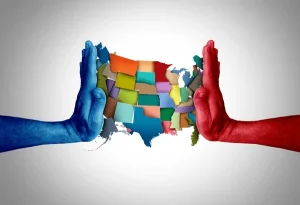 Since each tribe is a mashup of social values, religion and nationalism, there will inevitably be significant differences between tribes. In an ideal world, perhaps these differences would be tolerated, but this is not a perfect world. Tribes seek to validate their position by imposing their worldview on other tribes. Clashes are inevitable in this imperfect world.
I have used the term ‘tribes’ rather than ‘nationalities’ for a reason. I previously mentioned that several tribes can exist within a single country. Think of the catholics and protestants in Ireland. Remember the Hutus and Tutsis in Rwanda. Even in the USA, there are blocks of red states and blocks of blue states. They may not be at war, but they do belong to separate tribes.
If they cannot live, and let live, what are the reasons? Here are a few.
- One group blatantly seeks more power over the others. It is a struggle to expand an empire and to dominate more people and land.
- In various forms, money can drive one tribe against another. Colonisation during the last 500 years was driven by access to new riches. While Russia claims that Ukraine is traditionally part of Russia, access to the fertile lands is one of the main factors.
- The other tribe is seen as a threat to you, so you take preemptive action by attacking them.
- Missionary Zeal. Over centuries, there have been those who decided that any group that did not follow their religion must be converted. Almost every religion has sent forth missionaries to spread its version of god. It is not enough for Christians to live side by side with muslim or even another variety of Christians. They must be converted to my variety.
- Different customs. Sometimes this flows from religiously defined social values, but at other times, the fact that another tribe has different social values is enough to cause friction, war, and uncertainty. The treatment of gay people in the latter part of the last century in Australia, and many other countries, was because that tribe had different social values.
Where to from here?
Any improvement in how we live together is likely to be incremental and slow to happen. There are, however, some promising signs – at least for the optimistic.
Human rights. Three hundred years ago, it was perfectly normal for women not to have a say in government. Child slavery was practised in most countries. Little was done about poverty or disease. We have made some progress, but we are nowhere near achieving universal human rights. Maybe it will take another three hundred years.
Migration. Migration does two things. Firstly, it dilutes tribes. New arrivals bring new ideas and challenge the attitude that “we have always done it this way.” Secondly, it feeds back to the country from which migrants arrived. They usually have family and friends who come to visit and see another tribe, or they hear about how the new tribe works, and how their existing customs may need to be rethought.
Travel. As more people travel, they are exposed to different tribes with different ways of doing things. Conversely, the host countries are exposed to people from outside who bring new ideas.
Digital Media. I am regularly in touch with people from other tribes online. Whether in email or on social media, I get to see different points of view and life experiences. In the mid-1900s, movies brought the Hollywood way of life to the world. Some pieces stuck, and some were criticised. In any case, what the tribe from Hollywood created had an impact on other cultures. Bits were shared. They might highlight what a tribe does not want to accept, but they also bring most tribes marginally closer.
Economic Interdependence. People might love their iPhone, but the reality is that it could not exist without countries such as China, Vietnam, and India providing parts and assembly. As we become more interconnected through trade, we begin to iron out the cultural differences.
Secularism. In some places, the power of religion is waning. In Australia’s last census, 38.9% identified as no religion. In Iran, the population is becoming more secular and diverse. People are seeing the theocracy as an impediment to living normal lives and moving away to other religions or no religion at all. It is hard to know how many because many lead a double life. Complying with Islamic law in public and privately expressing secular views or supporting other religions. Over recent months, clashes between the police and the people have increased.
Education. Many religious beliefs and local customs are challenged by education. Providing knowledge is one way to alter tribal values. During the 7th and 8th centuries, the centre of the intellectual world was Baghdad and its Islamic scholars. The Christian world shunned new knowledge and for a time contracted, while the Islamic world grew throughout the Middle East.
Of course, used incorrectly, education can be a tool for brainwashing the younger generation. A school syllabus in Australia is not likely to be mirrored by a syllabus in a country run by an autocrat.
Conclusion
What can we learn from the interaction of religion, nationalism and social values? Here are four things.
Firstly, absolute loyalty to any tribe is a danger. It leads to blinkered thinking and intolerance.
Secondly, understand that in most cases, religion and social values are welded together. If a particular religion is to be criticised, be sure to point out which part of the package you are criticising.
Thirdly, where a person was born has no meaning when seeking differences. What their social values may be is the key differentiator. Generalisation rarely works. Even two brothers born in the same country may have totally different social values.
Finally, we each have social values shaped by religion, nationalism, and the customs of our forebearers. We have no right to impose those values on any other tribe. We are perfectly entitled to argue for them to change, but only under the most extreme circumstances, to impose that change by force. Another’s social value may not be the same as ours, but that doesn’t make it wrong.