Democracy, Autocracy, Capitalism and Socialism
Capitalism and Socialism
I was thinking about opposites. For a start, we have capitalism and socialism. What do they mean? Capitalism in its purest form means that business drives the economy. The pursuit of wealth dominates. The most ruthless risk-takers accumulate the most power and money. Anything that stands in the way of a growing business is bad.
Socialism is about sharing and supporting those who drew the short straw. About the community recognising that not everyone starts out equal, but that we should try to balance the books. We should try to provide the basics to everyone. Basics include food, shelter, medical support, education and an opportunity to climb the ladder to a better life.
Democracy and Autocracy
Another set of opposites is democracy and autocracy.
Democracy means the actions of governments should reflect the majority view of the electors. Governments collect and spend money responsibly to benefit the majority.
Autocracy is about central control. A single entity, unelected by the people, dictates how the country is managed, often for its own benefit. Substitute other forms of control for autocracy if you like. Theocracy, monarchy, military dictatorship, or familial dictatorship.
The conceptual difference is this. Democracy is about the people deciding their fate. Autocracy is about a single entity, be it a person, family or religion, deciding the fate of the people.
How do these fit together? We typically associate democracy with capitalism. We associate autocracy with all sorts of things, from socialism to a constrained and controlled form of capitalism. So, are these natural associations?
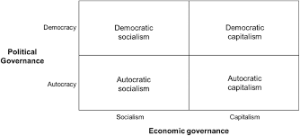 Democracy and Capitalism
I would argue that democracy and capitalism are diametrically opposed. Democracy is based around equaltiy. It assumes everyone has an equal say in how the country is run. Everyone is given equal opportunity. Everyone shares in success.
Capitalism, on the other hand, is based on consumption. Everyone should buy as much as possible. Those who deliver the most profit should be rewarded the most. The goal of marketing is to get more people to buy more products, regardless of whether they need them. To absorb every cent of income into corporate pockets. To charge the maximum price for that yields the highest profit. It is more akin to the law of the jungle.
America is probably the pinnacle of what happens when democracy and capitalism meet. When the two incompatible forces collide, what happens? Capitalism will try to remove impediments to more profit. Democracy will try to impose restraint in the business environment.
Capitalism Tactics
Turning to what capitalism has done over the last 100 years, we can see the following:
- Infiltrate the government by promoting people and parties that have a very capitalist view of how governments should run
- Create hundreds of lobby groups that influence politicians decision making to favour the corporate world
- Utilise the media (which is a capitalist enterprise in most cases) to promote the views of business
- Change society from one of caring for others to one of striving to get ahead
- Through politicians with capitalistic tendencies, change laws and rules to favour business
- Entrench capitalism in government through gerrymandering and voting rules that favour the rich
- Get governments to fund losses. Commercialise the profits and socialise the losses. Use terms like “Too big to fail.”
- Encourage governments to overspend and increase overall debt
Defecits
A fundamental of government is that it redistributes, not creates money. It collects taxes and delivers services and products to the population. In a perfect world, the amount collected would equal the amount spent. If the government, which should reflect community concerns, decides to provide additional services, it either stops delivering other services or raises taxes.
In the last few decades, we have seen this principle slip away. Deficits are seen as acceptable. Spend more than you raise. If a company were to do this, it would find itself out of business over time unless it were developing a game-changing product that would revolutionise the market. Governments don’t produce game-changing products, although expenditure can lead to future revenue. For example, infrastructure can generate income in the future.
Demand on the Government
One problem is that society is on a ladder. Once upon a time, it was accepted that the government would not provide health facilities or pensions or subsidise child care. Today they do. As people climb the ladder of government benefits, they see more benefits up another step. They demand that democracies provide additional benefits.
Unfortunately, we do not have a society ingrained with the concept of redistribution. People expect the government to provide benefits and somehow pay for them without changing tax rules. Democracies have done this in some cases and, in others, have just hidden tax changes through techniques such as bracket creep. In many cases, it has led to more government debt. Someone once said to me that if we took our taxation income from today and spent it on the things the government did in 1950, we would have an enormous surplus.
Democracy and Socialism
Democracy and Socialism sit more comfortably together. The people elect governments to improve their living standards. Socialism is about doing that. The Scandinavian example is always held up as a model for a socialist democracy.
Of course, it can have problems. The drive to gather more wealth is constrained by a socialist taxation system, and the wealth incentive is lower. This can lead to people using the system without making an equal contribution. Booming business growth is less likely if the government is going to ensure businesses meet certain standards and contribute a fair share of profits.
Autocracy and Capitalism
 Any discussion of autocracy comes down to the form of autocracy. The model that first comes to mind with autocracy and capitalism is the type of president who uses his or her power to create their own wealth. It might be Saddam Hussein, Kim Jong Un, Vladimir Putin, or the aspirations of the current White House incumbent.
On the other hand, an autocratic approach can work in some situations. If a boat is sinking, you don’t want a committee organising lifeboats. You want clear directions from the Captain.
In China, President Xi Jinping has turned the country around largely because he can act with ultimate authority. He has made mistakes, but can reverse direction quickly without political loss. He has ruthlessly purged those who oppose him, and there is some corruption. If you were Chinese, you would probably feel he had done more good than bad. Achieved things a democratic government could never have achieved.
Autocracy and Socialism
The final combination is Autocracy and Socialism. Countries like the Arab Emirates and Saudi Arabia have managed to distribute their enormous wealth to the people. There is certainly money that disappears along the way, but an autocratic government has improved people’s lives in many economic, educational, and social ways.
Singapore is a positive example. They have elections, but the same party has ruled since the country was established. It is sometimes called “soft authoritarian”.
Religion as a controlling force has been around forever. The Roman Empire was ruled equally by the church and the state for a thousand years. Sometimes it adds value to the process, and in other cases, like Iran, it is an impediment to people moving up the social ladder. It can also be an impediment when two religions compete. Ireland went through a long period of turmoil when Catholics and Protestants fought for control. Israel is in the midst of a religious war in one form or another.
Autocracies tend to “work” (in terms of stability or economic growth) when they have:
- Competent bureaucracy
- Rule of law within elite circles
- Economic openness or resource wealth
- Clear succession mechanisms
They tend to fail when:
- Succession becomes unstable
- Corruption overwhelms institutions
- Economic stagnation sets in
- Repression generates instability
Summary
Democracy, autocracy, capitalism and socialism can exist in various combinations. The problem is where one dominates. Kings were replaced by governments, but in some countries, a single entity is working well enough. Capitalism allowed the world to progress from the horse and cart to aeroplanes, but look where it has taken us over the last few decades. Socialism gave us protection for older citizens, public education and health facilities, but at a cost in taxation.
Perhaps the biggest lesson is that capitalism can overwhelm democracy. Over time, capitalism may infiltrate governments and destroy their power from within. They might use governments to remove constraints on their profit-making activities, absorb losses, subsidise their businesses and ultimately transfer taxation dollars into corporate purses. Capitalism, allowed to run wild, can end democracy.